Bacteriostatic water is water for injection with a benzyl alcohol preservative in a multiple-dose vial. The preservative is what separates it from sterile water; the absence of salt is what separates it from bacteriostatic saline. Read the label of the exact product in front of you.
The definition on the label
The pharmacopoeial product is called Bacteriostatic Water for Injection, USP. The manufacturer's prescribing information describes it as a sterile, nonpyrogenic preparation of water for injection containing 0.9% (9 mg/mL) of benzyl alcohol added as a bacteriostatic preservative, supplied in a multiple-dose container from which repeated withdrawals may be made. Some presentations use 1.1% benzyl alcohol instead. The label gives a pH of 5.7, within a range of 4.5 to 7.0.
Bacteriostatic means the preservative inhibits the growth of bacteria that might enter the vial once it has been opened. It does not sterilise anything, and it does not make the water suitable for a purpose the label does not state. Nonpyrogenic means the preparation is tested for fever-causing substances, which is a manufacturing specification rather than a feature you can see.
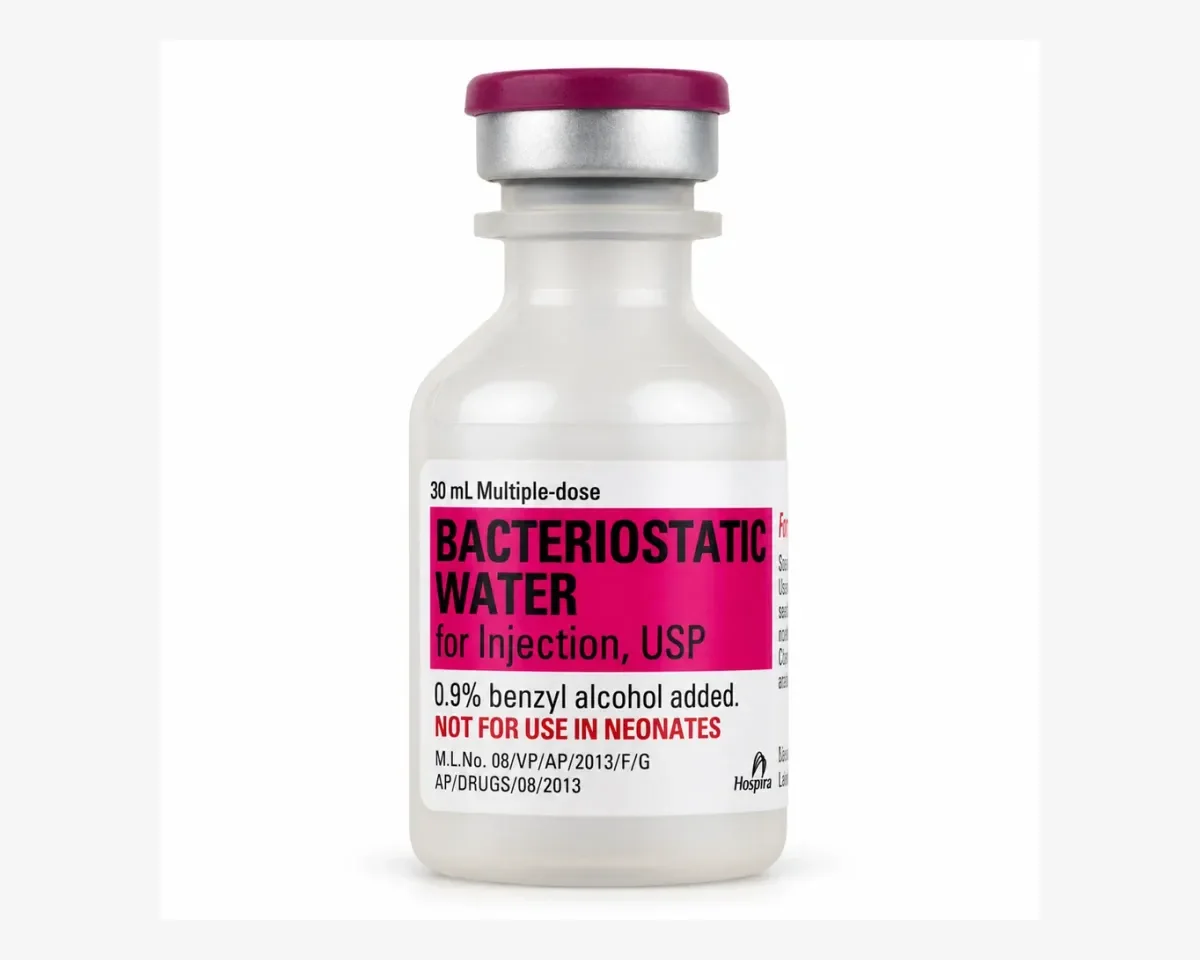
The same label carries a prominent warning that the product is not for use in neonates, because benzyl alcohol has been associated with toxicity in that age group. That warning is one reason the preservative content matters when two bottles of clear liquid look alike.
Three products that are often confused
Sterile water, bacteriostatic water and bacteriostatic saline are each sold in small vials and each contain water for injection. The labels differ in two things: whether a preservative is present, and whether sodium chloride is present. The table summarises what the three prescribing information documents say.
| Detail | Bacteriostatic water | Sterile water for injection | Bacteriostatic 0.9% sodium chloride |
|---|---|---|---|
| Preservative | 0.9% benzyl alcohol (1.1% in some presentations) | None: no bacteriostat, antimicrobial agent or added buffer | 0.9% benzyl alcohol |
| Sodium chloride | None | None | 9 mg/mL, an isotonic solution |
| Container | Multiple-dose; repeated withdrawals may be made | Single-dose only; discard the unused portion | Multiple-dose; repeated withdrawals may be made |
| Storage on the label | 20 to 25 °C | 20 to 25 °C | 20 to 25 °C |
| Neonate warning | Not for use in neonates | Volume may affect fluid balance in neonates | Not for use in neonates |
AUBACWATER own-label and Hospira are two different products
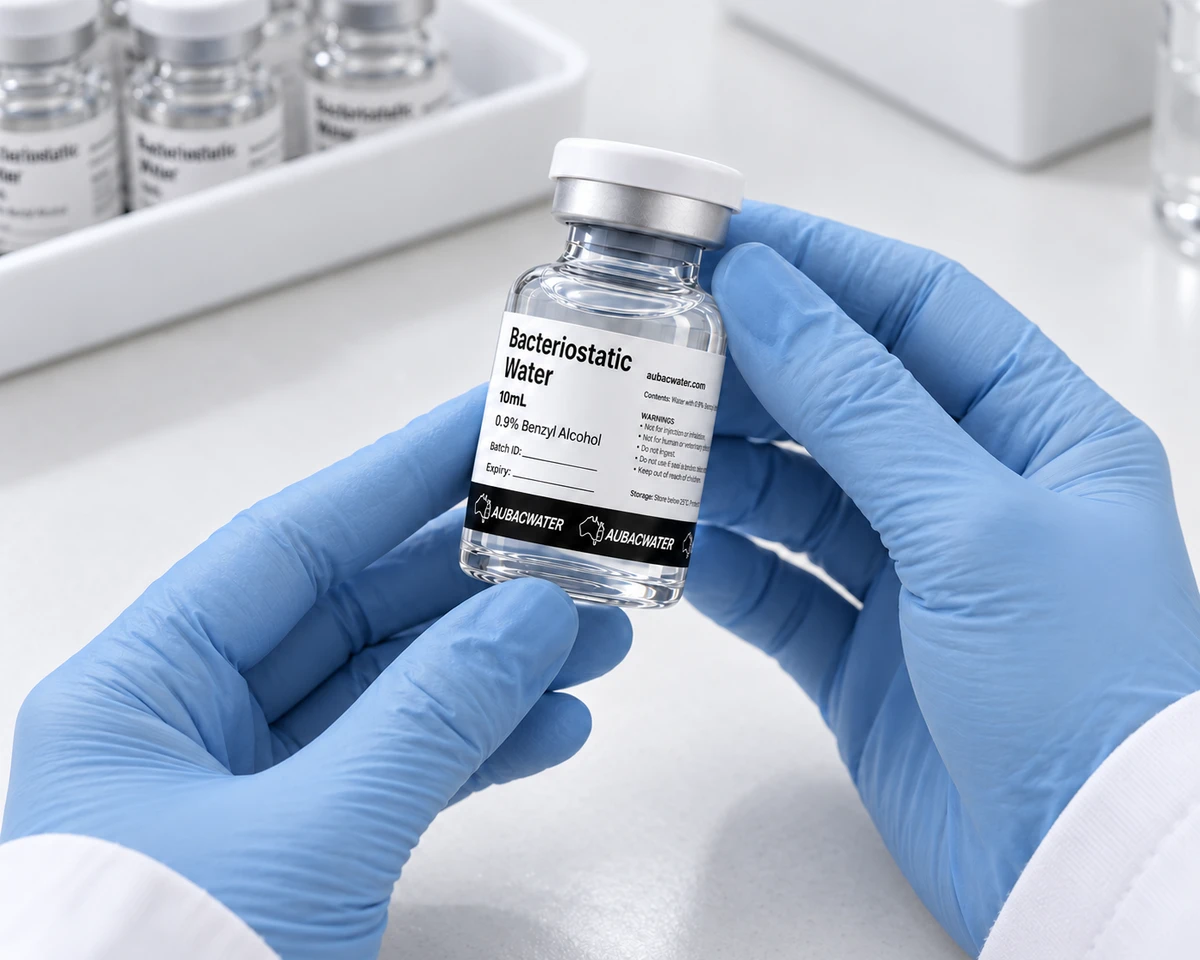
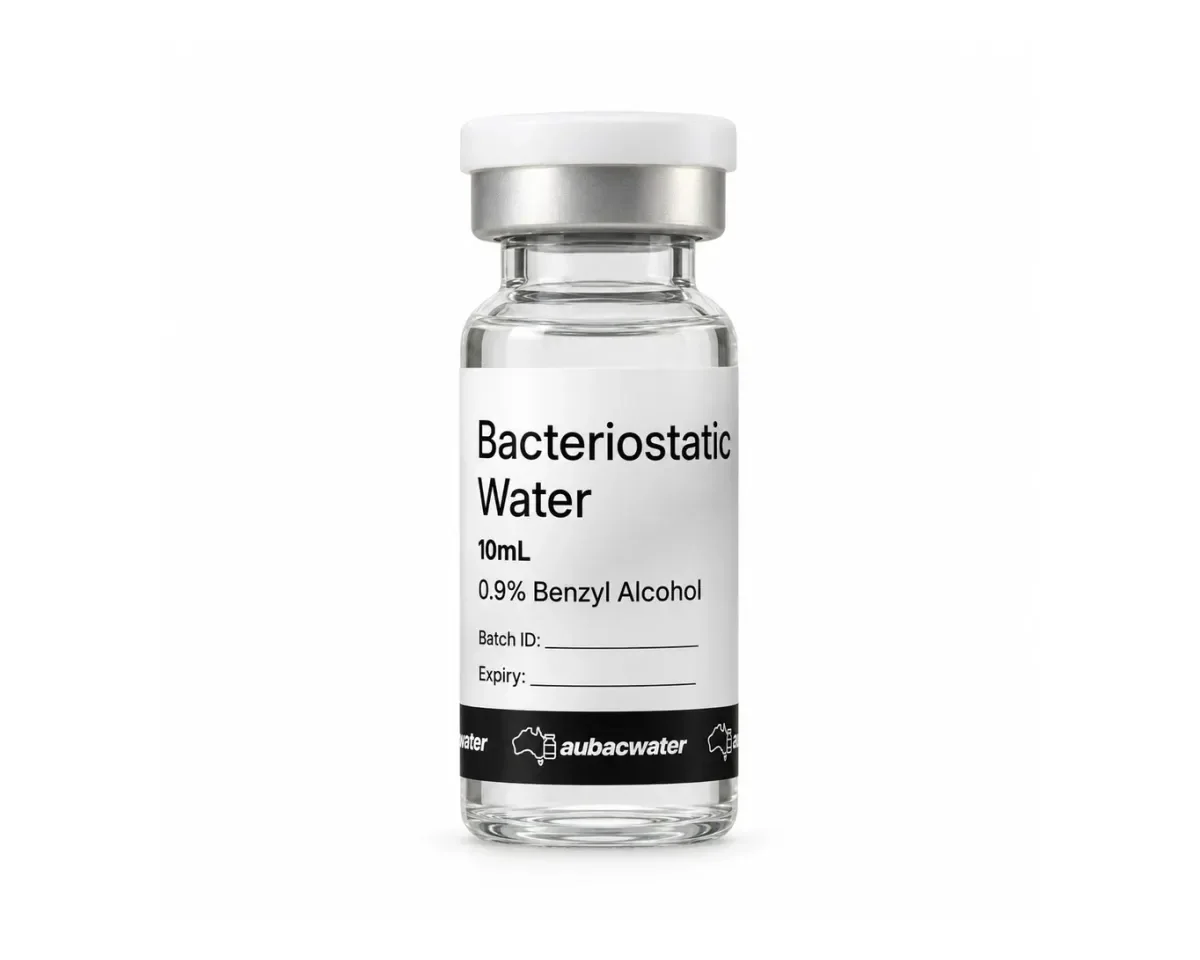
AUBACWATER's own-label range is bacteriostatic water with 0.9% benzyl alcohol in multiple-dose vials of 3, 10, 20 and 30 mL. It is supplied for laboratory use. Its label states that it is not for injection or infusion, not for human or veterinary administration, and must not be ingested. Those statements apply to every size and every pack.
Hospira's 30 mL vial is the manufacturer's own presentation of Bacteriostatic Water for Injection, USP, with Hospira's label, lot number and expiry date. Its US prescribing information marks it Rx only and describes it as a diluent for drugs that require dilution before injection, to be used only as directed by the manufacturer of the drug concerned and by qualified professionals. We list it separately and do not treat it as interchangeable with the own-label range, even though the preservative content is the same.
Terms you will see on a vial label
A few words on the label carry most of the meaning. These are the ones to check before comparing two products.
- Multiple-dose vial: a container designed for repeated withdrawals, which is why it carries a preservative.
- Single-dose: a container intended to be opened once, with any unused portion discarded; sterile water for injection is supplied this way.
- Preservative: the agent added to inhibit bacterial growth, here benzyl alcohol, stated as a percentage or in mg/mL.
- Nonpyrogenic: tested for pyrogens, substances that can cause fever.
- Lot or batch, and expiry: the identifiers that tie the vial to a production run and a date; record them when stock arrives.
- Store at: the temperature range on the label, 20 to 25 °C for the three products above; the label, not a website, sets any after-opening period.
- Rx only: a US labelling statement meaning prescription only in the United States; it describes that market's rules, not Australia's.
What this article does not cover
This is a buyer's explanation of what the products are and how their labels differ. It is not medical, veterinary or clinical advice, and it does not describe how any product is prepared, mixed or used. Follow the label of the exact product you hold and the direction of a qualified professional where the label requires it.
Sources
- Bacteriostatic Water for Injection, USP, multiple-dose vial: prescribing information published by Hospira, Inc. (DailyMed, US National Library of Medicine; label revised August 2019)
- Sterile Water for Injection, USP, single-dose: prescribing information (DailyMed, US National Library of Medicine)
- Bacteriostatic 0.9% Sodium Chloride Injection, USP, multiple-dose vial: prescribing information published by Hospira, Inc. (DailyMed, US National Library of Medicine)
These guides support product comparison and stock organisation. Follow the exact product label and intended-use information for the presentation you choose.